
Plastic Pipe Welding: Summer vs Winter | Seasonal Construction Rules & Guidelines
 Подписаться на раздел
Many people in plastic pipe construction believe that as long as welding is done according to standard temperature, time, and pressure parameters, the season doesn't matter. In fact, high summer temperatures and low winter temperatures directly affect the pipe's melting state, heat dissipation rate, and cooling effect. Using the same set of welding parameters all year round can lead to overheating and degradation in summer, or cold welds and false welds in winter — resulting in leaks, cracks, or even joint separation down the line.
The core construction logic, parameter standards, and protection requirements for plastic pipe welding are completely different between summer and winter. JIQING Group, drawing on field practical experience, provides a detailed breakdown of seasonal construction differences and key control points.
I. Core Summary: The Essential Difference Between Summer and Winter Welding
The essence of plastic pipe welding is to evenly melt the contact surfaces of the pipes, allow full molecular penetration and fusion, and then cool to set the joint. Ambient temperature directly affects heating/soaking efficiency, heat dissipation rate, and cooling time.
Simply put: Summer fears overheating; winter fears heat loss. You cannot use one set of parameters all year round.
II. Detailed Comparison of Summer vs. Winter Pipe Welding Construction
Aspect Summer (High Temperature) Winter (Low Temperature)
Environmental Characteristics High temperature, strong sunlight, slow heat dissipation — pipe body temperature is already elevated Low temperature, windy, rapid heat dissipation — pipes become brittle at low temperatures
Core Risks Excessive melting leading to brittle welds and cracking; thermal expansion and deformation from sun exposure causing misalignment Rapid heat loss at the weld, insufficient melting resulting in cold/false welds; reduced toughness leading to edge chipping
Heating Parameters Appropriately shorten heating/soaking time; avoid overheating to prevent material degradation Appropriately extend heating/soaking time and slightly raise temperature; increase compensation when ambient temperature is below 5°C
Cooling Requirements Slow, natural cooling; strictly no water spraying or forced cooling to prevent stress cracking Extend pressure-holding cooling time; ensure wind protection and insulation; prevent cold wind from blowing directly on the weld
Pre-weld Preparation Avoid direct exposure to the midday sun. Store the pipes in a shaded area. For long-distance pipelines, reserve the necessary expansion allowance as per the specifications. Weld indoors if possible; set up wind barriers outdoors; clear frost and moisture from pipe ends before welding
III. Summer Welding: Don't Be Fooled by "Good-Looking" Welds
High ambient temperatures, combined with heat from welding equipment, can easily cause excessive melting of the pipe material. Often, a weld may look good but crack later in service. Keep these key points in mind:
1. Strictly control heating parameters to prevent overheating
In high summer temperatures, the molecular activity of the pipe material is stronger. Heating/soaking time should be appropriately shortened. Excessively long heating times can cause carbonization and degradation of the contact surface, greatly reducing joint toughness and strength — creating a hidden crack risk.
Welding equipment should be preheated and stabilized in advance to ensure uniform plate temperature and avoid localized overheating.
2. Avoid sun exposure to prevent pipe deformation
During peak midday heat, pipes left in the sun can warp and deform, leading to misalignment and gaps during butt welding.
It is preferable to carry out construction during the cooler periods in the morning and evening. On-site pipe fittings should be stored under shade to avoid direct exposure to the sun. Long straight pipe sections should be constructed in accordance with the specifications, with reserved expansion allowances or using natural bends to compensate for thermal expansion stress.
3. Never use water for rapid cooling — allow natural cooling
The weld temperature is extremely high in summer, but you must never pour or spray water to cool it down. Sudden cooling creates intense internal stresses in the joint, leading to hidden cracks that will eventually leak. The weld must be allowed to cool naturally.
IV. Winter Welding: Insulation Matters More Than Heating
Winter brings low temperatures and frequent windy days. Outdoors, the heat dissipation rate from pipes is several times faster than in summer. The weld cools too quickly, resulting in incomplete melting and failed molecular bonding.
The core of winter construction is: compensate for heat loss, block the wind, and extend cooling time.
1. Raise temperature or extend heating time appropriately
When ambient temperature falls below 5°C, adjust the process: moderately extend heating/soaking time or slightly increase the heating temperature to compensate for heat loss and ensure thorough melting. Also, start the welding equipment 10–15 minutes early to allow stable plate temperature.
2. Wind protection is the top priority
Cold winter wind is the hidden enemy of welding. Drafts rapidly strip heat from the weld zone, causing joint failure. Outdoor construction must include wind barriers. After the weld is formed, keep it insulated and prevent cold wind from blowing directly on it.
3. Extend pressure-holding and cooling time — don't rush to release pressure
In winter, pipes cool faster and are less tough. Releasing pressure too early can cause joint springback or cracking. Extend the pressure-holding cooling time and wait for the weld to cool completely and stabilize before removing clamps or moving the pipe.
Conclusion
Plastic pipe welding in summer and winter absolutely cannot use the same set of construction parameters. In summer, protect against sun exposure and slow down cooling. In winter, block cold wind and extend the setting time. Adjusting welding processes, protection measures, and cooling standards according to seasonal temperature changes is the only way to completely avoid false welds, cracking, and leaks.
JIQING Group has years of experience in plastic pipe manufacturing and construction. We provide one-stop welding and installation services — from process adjustments to on-site protection — tailored to different climate conditions, ensuring quality and stability for municipal, chemical, and new energy pipeline projects.
Фотогалерея статьи
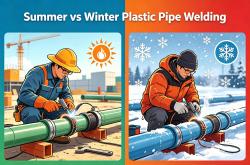
The core construction logic, parameter standards, and protection requirements for plastic pipe welding are completely different between summer and winter. JIQING Group, drawing on field practical experience, provides a detailed breakdown of seasonal construction differences and key control points.
I. Core Summary: The Essential Difference Between Summer and Winter Welding
The essence of plastic pipe welding is to evenly melt the contact surfaces of the pipes, allow full molecular penetration and fusion, and then cool to set the joint. Ambient temperature directly affects heating/soaking efficiency, heat dissipation rate, and cooling time.
Simply put: Summer fears overheating; winter fears heat loss. You cannot use one set of parameters all year round.
II. Detailed Comparison of Summer vs. Winter Pipe Welding Construction
Aspect Summer (High Temperature) Winter (Low Temperature)
Environmental Characteristics High temperature, strong sunlight, slow heat dissipation — pipe body temperature is already elevated Low temperature, windy, rapid heat dissipation — pipes become brittle at low temperatures
Core Risks Excessive melting leading to brittle welds and cracking; thermal expansion and deformation from sun exposure causing misalignment Rapid heat loss at the weld, insufficient melting resulting in cold/false welds; reduced toughness leading to edge chipping
Heating Parameters Appropriately shorten heating/soaking time; avoid overheating to prevent material degradation Appropriately extend heating/soaking time and slightly raise temperature; increase compensation when ambient temperature is below 5°C
Cooling Requirements Slow, natural cooling; strictly no water spraying or forced cooling to prevent stress cracking Extend pressure-holding cooling time; ensure wind protection and insulation; prevent cold wind from blowing directly on the weld
Pre-weld Preparation Avoid direct exposure to the midday sun. Store the pipes in a shaded area. For long-distance pipelines, reserve the necessary expansion allowance as per the specifications. Weld indoors if possible; set up wind barriers outdoors; clear frost and moisture from pipe ends before welding
III. Summer Welding: Don't Be Fooled by "Good-Looking" Welds
High ambient temperatures, combined with heat from welding equipment, can easily cause excessive melting of the pipe material. Often, a weld may look good but crack later in service. Keep these key points in mind:
1. Strictly control heating parameters to prevent overheating
In high summer temperatures, the molecular activity of the pipe material is stronger. Heating/soaking time should be appropriately shortened. Excessively long heating times can cause carbonization and degradation of the contact surface, greatly reducing joint toughness and strength — creating a hidden crack risk.
Welding equipment should be preheated and stabilized in advance to ensure uniform plate temperature and avoid localized overheating.
2. Avoid sun exposure to prevent pipe deformation
During peak midday heat, pipes left in the sun can warp and deform, leading to misalignment and gaps during butt welding.
It is preferable to carry out construction during the cooler periods in the morning and evening. On-site pipe fittings should be stored under shade to avoid direct exposure to the sun. Long straight pipe sections should be constructed in accordance with the specifications, with reserved expansion allowances or using natural bends to compensate for thermal expansion stress.
3. Never use water for rapid cooling — allow natural cooling
The weld temperature is extremely high in summer, but you must never pour or spray water to cool it down. Sudden cooling creates intense internal stresses in the joint, leading to hidden cracks that will eventually leak. The weld must be allowed to cool naturally.
IV. Winter Welding: Insulation Matters More Than Heating
Winter brings low temperatures and frequent windy days. Outdoors, the heat dissipation rate from pipes is several times faster than in summer. The weld cools too quickly, resulting in incomplete melting and failed molecular bonding.
The core of winter construction is: compensate for heat loss, block the wind, and extend cooling time.
1. Raise temperature or extend heating time appropriately
When ambient temperature falls below 5°C, adjust the process: moderately extend heating/soaking time or slightly increase the heating temperature to compensate for heat loss and ensure thorough melting. Also, start the welding equipment 10–15 minutes early to allow stable plate temperature.
2. Wind protection is the top priority
Cold winter wind is the hidden enemy of welding. Drafts rapidly strip heat from the weld zone, causing joint failure. Outdoor construction must include wind barriers. After the weld is formed, keep it insulated and prevent cold wind from blowing directly on it.
3. Extend pressure-holding and cooling time — don't rush to release pressure
In winter, pipes cool faster and are less tough. Releasing pressure too early can cause joint springback or cracking. Extend the pressure-holding cooling time and wait for the weld to cool completely and stabilize before removing clamps or moving the pipe.
Conclusion
Plastic pipe welding in summer and winter absolutely cannot use the same set of construction parameters. In summer, protect against sun exposure and slow down cooling. In winter, block cold wind and extend the setting time. Adjusting welding processes, protection measures, and cooling standards according to seasonal temperature changes is the only way to completely avoid false welds, cracking, and leaks.
JIQING Group has years of experience in plastic pipe manufacturing and construction. We provide one-stop welding and installation services — from process adjustments to on-site protection — tailored to different climate conditions, ensuring quality and stability for municipal, chemical, and new energy pipeline projects.
| Источник: | Собственная информация |
| Учетная запись: | Jiangsu Jiqing Pipe Group Co., LTD. |
| Дата: | 18.06.26 |
| PPH Pipe | Corrosion-resistant High-Quality Polypropylene Homopolymer Pipe | Hot melt over-welding example | Jiqing Group |